
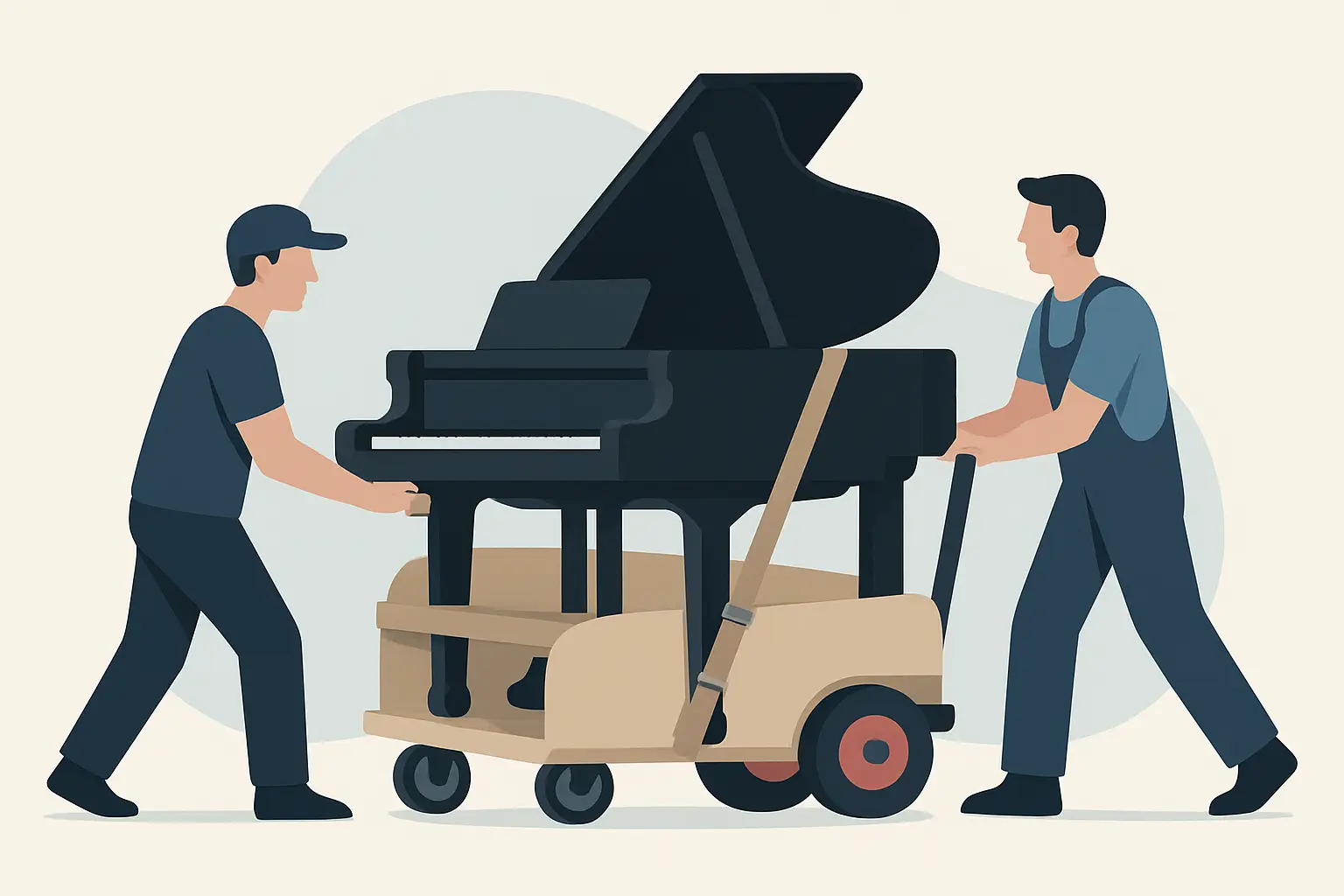
If you have ever watched someone try to “just roll” a piano across a floor, you already know how these jobs go sideways. A caster digs in, a leg twists, a threshold catches, and suddenly you are dealing with a cracked tile, a gouged hardwood plank, or worse – an injured back and a piano that will never feel the same.
That is exactly why piano moving with skid is a standard in professional moves. A skid does not make a piano light, but it makes the load predictable. Predictable is what keeps your floors intact, your stairs intact, and your instrument intact.
What “piano moving with skid” really means
A piano skid (often called a piano board) is a rigid platform designed to cradle the piano so it can be moved as a single, stabilized unit. Instead of relying on fragile legs and small casters, the piano is secured to the skid with straps and padding, creating a wider, flatter base that can be controlled by multiple movers.
For grand and baby grand pianos, the skid is the backbone of the whole move. The piano is typically placed on its side, protected with thick pads, then strapped tightly to the skid so it cannot shift when passing doorways, turning corners, or going up and down stairs.
For uprights, a skid is sometimes used, sometimes not. It depends on layout, stairs, flooring, and the type of upright. A short console on a straight shot out of a ground-floor room is a very different job than a tall upright on a narrow staircase with a sharp landing turn.
Why a skid changes the risk profile
Pianos are heavy, awkward, and top-heavy in all the wrong ways. Even “small” uprights can be 400-600 pounds, and grands can reach well past 1,000 pounds. The risk is not only the weight – it is where that weight sits and how it behaves when the piano tilts.
A skid helps in three practical ways.
First, it takes stress off the legs and casters. Piano legs are not designed to handle lateral forces from rolling over thresholds or being tugged around corners. Once the piano is secured to a skid, those weak points stop being your moving system.
Second, it spreads contact. A wider base reduces pressure points that can dent hardwood or crack tile. A skid also plays better with floor runners and protective blankets, which helps when moving through hallways and tight rooms.
Third, it gives your team control. With a strapped load, the piano does not “walk” or sway with each step. That stability is what keeps a move from turning into a wrestling match.
When a skid is the right call (and when it might not be)
A skid is the right call for most grand and baby grand moves, and for uprights that involve stairs, narrow turns, or delicate flooring. If you are dealing with stone tile, engineered hardwood, or freshly finished floors, you want to reduce rolling and pivoting on small casters.
That said, it depends. In a few scenarios, adding a skid can create new problems. If you have extremely tight clearance – for example, a hallway that already barely fits the piano – the added thickness of pads and the skid can make the difference between “fits” and “does not fit.” Another trade-off is setup time. Properly padding, tipping, and strapping a piano takes time and skill. Rushing that process defeats the point.
The decision should be based on the path, not just the piano. Professionals map the route first, then choose the control method that best matches the risks.
How pros use a skid without beating up the piano
Most piano damage happens at the same moments: tipping, threshold transitions, stair starts and stair finishes, and truck loading. A skid is meant to reduce the chaos at those moments, but only if it is used correctly.
Step one: route planning and measurement
Before anything moves, the team should confirm the route from the piano’s current spot to the truck and from the truck to the final room. That includes door widths, hallway pinch points, stair geometry, and landing turns.
If the route forces the piano to pivot tightly, the crew needs to know that before the piano is strapped to a board. Planning is also where you decide what protection goes down on floors and stairs. Floor runners, corner guards, and padding at railings and newel posts often matter as much as the skid.
Step two: proper padding that stays put
Padding is not just “throw a blanket on it.” A piano has edges, corners, pedals, and finishes that scratch easily. High-contact areas need thick moving pads placed so the piano’s weight does not grind the pad out of position.
Many teams add stretch wrap over the pads to keep them from sliding. The wrap is not there to protect the finish by itself. It is there to keep pads stable so straps do not bite into the cabinet.
Step three: controlled tipping and placement on the skid
For grand and baby grand pianos, the piano is usually tipped onto its side onto the padded skid. This is a controlled motion. It is not a “one big heave.” You need enough hands, coordinated communication, and the right grip points.
For uprights, tipping may be minimal or not required, but the same idea applies: keep the center of gravity controlled and never rely on one person’s strength to “catch” the load.
Step four: strapping that locks the load
A skid only works if the piano is secured tightly. Loose strapping lets the piano shift, and shifting is what breaks things. Straps should be snug enough that the piano cannot move independently of the board, with padding underneath where straps contact the instrument.
On stairs, professionals often add a second layer of control – such as a stair-climbing plan with dedicated spotters and a clear command voice – because the skid is stabilizing, but gravity is still gravity.
Step five: transitions, thresholds, and the truck
Thresholds are where floors get chewed up and pianos get jolted. A good crew uses threshold ramps or bridging pieces so the skid does not slam down. The same goes for the truck ramp or liftgate. Smooth, supported transitions keep the piano from taking shock loads.
Inside the truck, the piano should be positioned to prevent shifting in transit, then strapped to anchor points. A skid is not a substitute for load securement. It is one part of the system.
Common mistakes we see with DIY skid setups
People get into trouble when they hear “piano board” and assume it is a magic trick. It is not. Here are the failure points that show up again and again.
Using a homemade board that flexes under load. If the board bends, the straps loosen and the piano moves.
Strapping directly over delicate trim without padding. Straps can crush edges and leave permanent impressions.
Trying to move on stairs without enough people. A skid can make a piano easier to control, but it does not reduce the mass.
Rolling over floors without proper runners or protection. Even a skid can grind grit into hardwood if the route is not protected and kept clean.
Underestimating turning radius. Tight corners can force awkward pivots that put stress back onto the piano’s weakest points.
If any of those sound like your situation, it is usually cheaper to slow down and bring in trained movers than to repair a damaged piano or a damaged staircase.
What to ask a mover before you book a piano move
A reputable crew should be able to explain their method in plain language. You are not being difficult by asking. You are protecting your home and your instrument.
Ask whether they use a dedicated piano skid (not just a dolly) for grand or baby grand pianos, and under what conditions they use one for uprights. Ask what they do to protect floors and stairs, and whether they have the right straps, pads, and runners on the truck that day.
Also ask about insurance and worker coverage. Piano moves are a high-risk category, and you want a team that is licensed and insured, with proper worker coverage, not a “cash crew” improvising on your landing.
Real-world scenarios where skids earn their keep
If you are moving a grand out of a living room with a tight doorway, the skid lets the crew control the tilt and angle without torquing the legs. If you are dealing with a staircase, the skid creates a stable footprint that multiple movers can guide, while spotters manage clearance at walls and railings. If you have a long hallway with hardwood, the combination of floor runners and a skid reduces the odds of those long, ugly drag marks that never quite disappear.
The skid is not about brute strength. It is about reducing unpredictable movement – the sudden shifts that lead to damage.
A professional standard that matches a professional instrument
Most people only move a piano a few times in their life. Movers do it weekly. That difference matters because the details matter: how the pads are placed, how the straps are tightened, how the stairs are approached, and how the load is secured for transport.
At Baker Home Solutions, we keep specialty equipment like piano skids in our standard kit because jobs go better when the right tool shows up with the truck. If you are planning a move and you have a piano on the inventory list, build your plan around control and protection first, speed second.
A good piano move feels almost quiet. No scraping, no bouncing, no panic – just a heavy instrument traveling safely from one room to the next, the way it should.